





Memories on the Line: A Personal Archive of LA’s Lost Payphones
Words and Images by Ryan Steven Green


“The [D]Evolution of...” coin-operated telecommunications in the 21st C. The very day this site was discovered to me by a follower of @payphonesoflosangeles, I drove down to Vernon to get some shots of the trio. Memorialized on Kodak Gold 200 with my Minolta X-700, this single image encapsulates just about everything that seven years of documenting the payphones of Los Angeles represents to me.
When I heard that Luther Burbank Elementary School had closed for lack of enrollment, my heart felt a tug. To think that the sound of children’s voices would no longer echo across the asphalt playground felt like part of my own past had been silenced: as if the perpetual presence of a new crop of students somehow kept me connected to a season of my life long gone. Maybe this is just part of aging, something everybody experiences in one way or another. But for me this emotion launched a multi-year mission to document...payphones.


To this day, the rusty stumps of the anchoring bolts that held that pedestal in place are still visible in the sidewalk in front of Hi Ho Market, now Eddie’s Liquor, where my long-deceased uncle stood.
It started when I began noticing payphones around Pasadena were disappearing and I felt that same tug. Things change, I get it. But some of these were phones I had used as a youth coming up in Altadena. Surely that wasn’t that long ago... was it?
A number of the earliest images I captured feature nothing but a scarred patch of concrete. And memories. One in particular was of a vanished Highland Park phone that was the last place I ever saw Uncle Larry living. I was 22 years old and he was talking on it when my dad and I happened to drive past.
I soon found myself pulling over each time I passed a new payphone. Even more telling, I began driving new routes in hopes of discovering a trove of unseen specimens. It was not a great leap from there to going on purposeful “hunts,” each of which would yield anywhere from twenty to forty new phones. By that time I had begun to realize this was more than just a passing fancy.
When I finally paused to consider exactly what I was hoping to accomplish with this newfound past-time, I already had a collection of around 300 payphone images on my phone. And to be sure, the irony of documenting this obsolete technology with the one that replaced it was not lost on me. Without any long-term goal in mind, I put my smartphone to further use and began posting to InstaGram under the moniker @payphonesoflosangeles–my first Instagram page. While I had (have) no especial affinity for social media, I saw the platform as an expedient way to display this growing collection of images and memorialize the dying technology it depicted.
From the start I adhered to two rules: first, each payphone location would appear in the feed only once; second, I’d include a precise address with each photo. The intent was to create a true, living archive accessible to all. But as the page grew and started to get attention—and especially once I noticed phones I had already shot were being removed—both of these rules fell by the wayside. But they held throughout my most active years of documenting with my smartphone, 2018 - 2022.


Now I love photography, but as a career documentary filmmaker montage, moreso than the singular image, is the artistic language I speak natively. This was the reason I photographed each phone with the same framing: I had conceived of the InstaGram feed itself as a timelapse. Echoes of Godfrey Reggio’s Qatsi Trilogy. It was also why I was always looking for ways I could utilize my storytelling strengths to further distinguish the project.
It took three years of continual shooting, but eventually I did create an actual timelapse, boiling down over 1,000 images to 180 and then sequencing the selects to, “create a haunting illusion: one continuous disintegration, composed of many.” This animation landed me a book publisher and itself is the content of Your Call Has Been Disconnected, a flipbook from Spanish publisher Flipboku. The above quote is from the flipbook’s slipcase.
Also from the flipbook slipcase: “The illusion of continuous decay speaks to a broader story of obsolescence, memory, and the quiet disappearance of once-familiar street fixtures. A tribute to analog beauty–and to what we leave behind.”
In reality, the disintegration does not happen in so linear a fashion. Sometimes the coinbox is the first thing to go; sometimes it’s the last remaining vestige. A working payphone may lack an enclosure. An otherwise intact enclosure may lack a payphone. In some cases the overhead blue sign is missing; in others the blue sign is the only evidence there was ever a phone there at all.
As the encounters mounted and the archive grew, key questions began to color the project and shape its major themes: why were these booths simply left to rust in place? How do locals respond and adapt to the continued presence of this immovable junk in their community? Are there any more working payphones, and if so where?
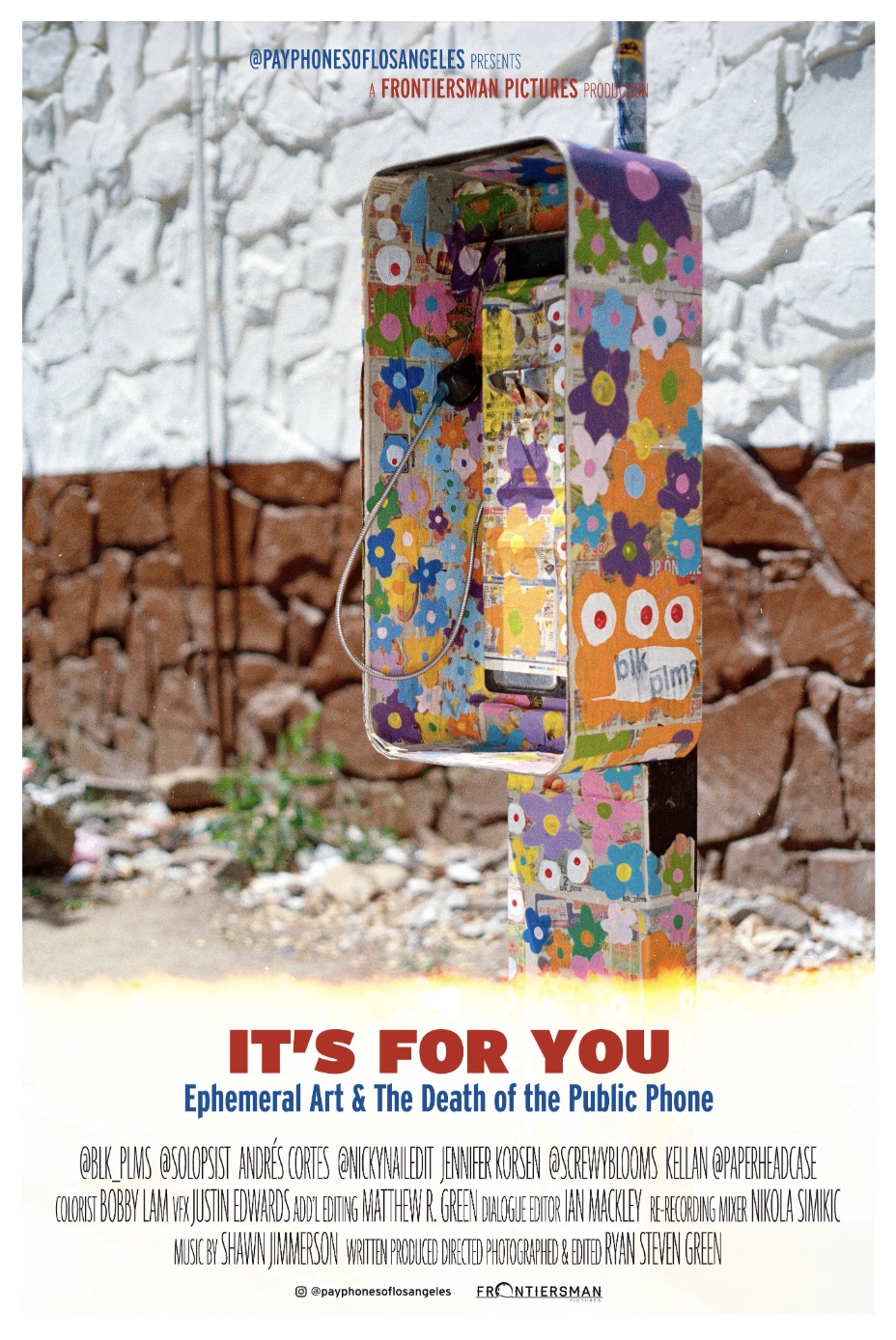

The official poster for It’s For You features a film image of a Highland Park payphone (formerly of Uno Market, since removed) adorned by the street artist Black Palms. The film’s synopsis reads: “Utilizing such varied materials as concrete, papier-mâché, and blown-out tires, disparate Los Angeles street artists give new life to the dwindling remnants of the city’s public payphones by repurposing them as canvases for unique expressions of a moment in time. With the streets as their gallery, our heroes defy vandalism laws, maintenance crews, haters, and history itself to deliver a moment’s levity to the right kind of passerby. By keeping its focus on the artists, the phones, and the ephemeral nature of both art and technology, this short documentary thoughtfully invites its audience to appreciate what’s being lost as the world moves on.”
Seeking answers had wide ranging consequences that would consume my free time for over seven years and result in one of the most prolific creative seasons of my life. Emanations included: the expansion of the digital archiving to include film photography; four solo photography exhibitions; a literal funeral for the payphone; a series of eleven micro-documentaries; a number of lectures; a book of film photography on LA street artist screwyblooms whose work is singularly focused on, and in, the payphone; the aforementioned flipbook; and, ultimately, the award-winning documentary It’s For You: Ephemeral Art & The Death of the Public Phone, which created its own ecosystem of screenings, events, and lectures that continue to this day.
One very unique revelation during this season was the discovery of California’s Public Utilities Commission (PUC), the regulatory agency responsible for keeping a record of the working payphones in the state. Thus began an intermittent correspondence with Regulatory Analyst Stanley Lee that would last for around two years. One day Stanley blew my mind when he emailed an Excel spreadsheet listing the address of every single payphone in Los Angeles County, its assigned phone number, and its working status (99% of entries say “unclaimed”, i.e. not working). Each entry also includes the owner of that phone. Names like Starwest Public Coin, Quantum Telequip, Orion Skywalker, The Payphone Guy, Praytel Communications, Phones R Us, and Beethoven Comm. (in addition to the expected litany of corporate giants such as AT&T, Verizon, and Frontier) speak to the once-crowded field of telecommunications companies in the coin-operated game. Weighing in at nearly 90,000 rows, it’s an immense document. However, it’s telling that the number of rows has not increased since 2002, the year that PUC began keeping the record.
Through insight gleaned from the spreadsheet as well as my own research, I deduced that at peak payphone usage in the mid-late 1990s there were more than 60,000 concurrently working payphones spread across Los Angeles County (Stanley thought my estimate conservative). Yet at the time of our correspondence in 2023, there were fewer than 1,000 working phones remaining—a 98.333% decline in the span of just twenty years.
Cell phones are, without a doubt, a primary contributor to this real-time mass extinction event. But they’re not alone. In conversations with other researchers as well as Steve Littlejohn, owner of the last remaining payphone company in Los Angeles, the cost of upkeep has gone up. The cost of copper, on which landline telephones depend, has become prohibitive, and the only supplier of those copper lines, AT&T, is actively divesting in the technology.
So-called “Obamaphones” also played an outsized role in killing the payphone. When President Obama put his twist on the FCC’s Lifeline initiative and unveiled a plan to get cell phones into the hands of every low-income American, enrollment tents were strategically set up in the one place that was sure to attract participants to the program: payphones.
I once had lunch with Steve Littlejohn. Over a hot turkey sandwich at Tallyrand in Burbank he spoke these words to me,
“Unless the government steps in, a few more years and there won’t be a single working payphone left.”
While PUC records indicate the last known count of working phones, it’s impossible to know just how many derelict phones are still out on the street. While I’ve personally documented a few thousand of them, I don’t believe I’ve come close to covering what remains across LA County. What I have noticed though is that removal efforts seem to have greatly accelerated post-pandemic. The reasons are not entirely clear to me, especially as there is no centralized, or city-wide directive towards this inevitable end.


I began by mentioning that my elementary school, Luther Burbank in Altadena, is no more. The campus is now protected by a security fence and occupied by a charter school. One day I dialed up the office of Stratford School and was answered by a kind young woman:
"Hi, weird question, but I went to elementary school at Luther Burbank. I’m working on a project documenting the disappearing payphones around Los Angeles and, I hope I didn’t just dream this, but… in the main hallway out front of the auditorium there is a tiny little closet. Is there still a payphone in there?"
The Office Administrator was certain there was never a payphone in the custodial closet, but she said she’d take a look.
The next day I received an email:
“It was a pleasure speaking with you yesterday. After our conversation, I checked out the custodial closet and found this area that looks remnant of a payphone.”
Two photos were attached to the email.


Photos courtesy of Angela Andikyan. Used with permission.


Ryan is a documentary filmmaker from Los Angeles with a passion for uncovering forgotten regional history and niche cultural practices. His superpower is transforming overlooked curiosities into compelling cinematic experiences that are informative, entertaining, and move the viewer to wonder and greater possibility.
Born in Glendale, raised in Altadena, graduated Arcadia High School and the school of Cinematic Arts at USC. Ryan is married to an endlessly gracious woman from Long Beach and called “Dada” by three spirited young humans. In addition to the 40+ documentary titles he's directed, he tells stories for some of the world’s most well-known brands.
⟣DISAPPEARANCE⟢
More Stories
↓ ↯ ⬇︎ ⇣
Editors
Akosa · Stephanie Becker · Elena Diebel · Catherine Falls · Jenny Galipo
Sarah Jardini · Lisa Kahn · SL Leimbach · Vern Molidor · Kelli Yakabu
Editor-in-Chief
Jen Neville
Design
Zaira Torres
More selected projects
Sign-up to be a member of LAAC
Connect With Us


Original site design by Grace Danico, 2016,
Site Administrators: Jen Neville & Zaira Torres